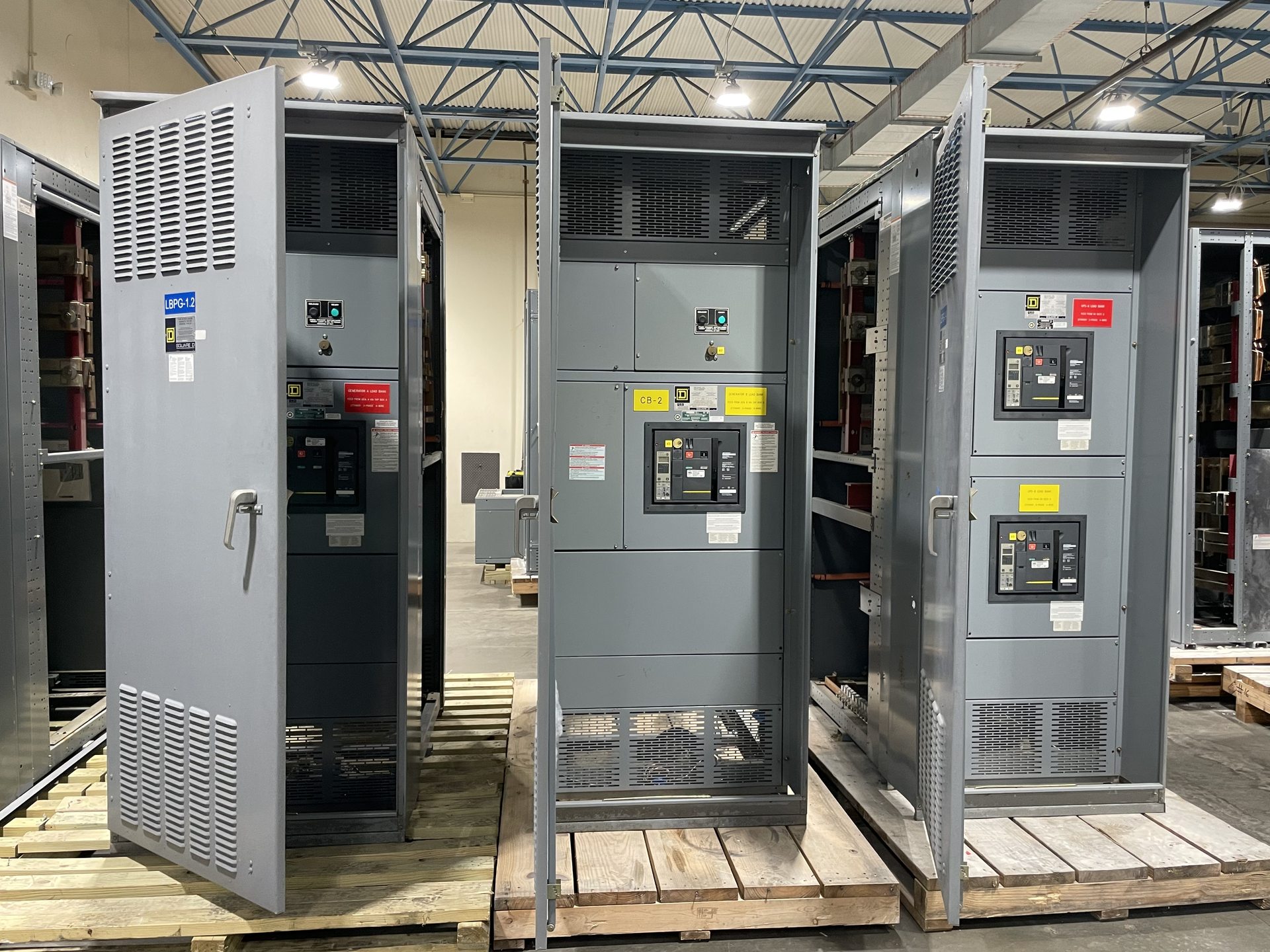
Start with the lineup, not an assumed construction type
When considering a surplus switchgear sale, begin with what the available records and safely accessible exterior labels actually identify. “Metal-clad” may be the description used in a facility inventory, but do not infer construction type from appearance, a partial label, or the fact that breakers draw out. Construction details should come from equipment documentation or verified identification, not guesswork. If the records are incomplete, say so; uncertainty is more useful to an evaluator than a confident but unsupported classification.
Describe the equipment as a lineup or assembly and record each labeled section separately. Existing section designations, such as a lineup number or the function shown on a door label, can help distinguish one section from another. Include the number of sections represented in the available information and note any gaps, mismatched labels, or sections whose identity is unclear. There is no need to open compartments or approach equipment to collect details.
Keep section information separate from breaker counts
A section and a drawout breaker are not the same inventory item. Record the labeled sections as one part of the description, then list the included breakers separately where that information is already known. For example, an inventory might identify several labeled sections and separately note that it lists two drawout breakers, with one breaker’s identification uncertain. This avoids implying that every section contains a breaker or that every breaker is included in a sale.
For each breaker, share safely accessible exterior identification such as a label, catalog or type designation, serial number, and nameplate ratings, if available. State whether the breaker is listed as included, listed as missing, or simply unconfirmed. Do not treat a breaker shown in an old drawing as proof that it remains with the lineup. If an inventory does not distinguish the breaker from its cell or section, explain that limitation rather than assigning it a location based on assumption.
Use labels and records carefully
Useful information may include the manufacturer and lineup identification shown on labels, section designations, breaker identifiers, available drawings, and the date or source of an inventory. Photos can help when they are taken from a safe, accessible position without opening equipment or entering an unsafe area. Sellers are not expected to obtain information that is inaccessible, and missing details do not prevent an initial inquiry.
Keep equipment ratings distinct from present operating conditions. A nameplate voltage rating describes equipment identification; it does not establish the live voltage at the equipment or confirm that the system is energized, isolated, or otherwise in a particular condition. Report known operating or condition information as known, and mark unverified details as unknown. Never touch energized equipment. Sellers must not open, operate, or approach energized equipment or enter unsafe areas.
Explain condition without testing
Share condition details already documented or safely known: whether the equipment is described as surplus, used, decommissioned, or still installed; whether records identify missing components; and whether the reported condition comes from an inventory, maintenance record, or direct prior observation. Avoid turning an old status note into a current fact. If the equipment remains installed or operating, an authorized seller may still inquire using information already available, without inspecting it or changing its condition.
Testing is not required for the buyer to consider equipment. Do not perform tests or arrange tests for the purpose of making an inquiry. A clear statement such as “breaker condition not verified” is preferable to an unsupported claim that a breaker works. The buyer considers surplus, used, and decommissioned switchgear across voltage classes, including equipment from closed data centers and power plants; that does not guarantee that any particular lineup or component will be purchased.
Provide context for an evaluation
Along with the inventory, an authorized seller can provide the equipment location, ownership information, available photographs or records, and the appropriate point of contact. Clarify whether listed breakers, accessories, or other components are included in the equipment being discussed, and identify anything whose inclusion is not confirmed. If multiple lineups are present, distinguish them using existing labels or facility records rather than relying only on a general description such as “switchgear in the electrical room.”
A seller may request a cash offer, but an offer or purchase is not guaranteed. The company buys equipment; it does not sell switchgear to the inquirer. If equipment is purchased, payment is upfront. The value and decision depend on the equipment information and evaluation, so do not assume that a particular rating, section count, or breaker count assures a price.
Know who handles purchased equipment
For equipment the buyer purchases, the buyer handles disconnects, crane and rigging, loading, freight, and hauling, and covers freight. The seller does not perform or arrange those operations. Do not disconnect, move, lift, load, or ship equipment to prepare for a sale discussion. If the equipment is still installed, provide its known location and status and leave handling arrangements to the buyer if a purchase proceeds.
A concise, honest inventory—labeled sections separated from included drawout breakers, with unclear details marked accordingly—gives the buyer a practical basis for review without asking facility personnel to take risks or fill gaps by assumption.