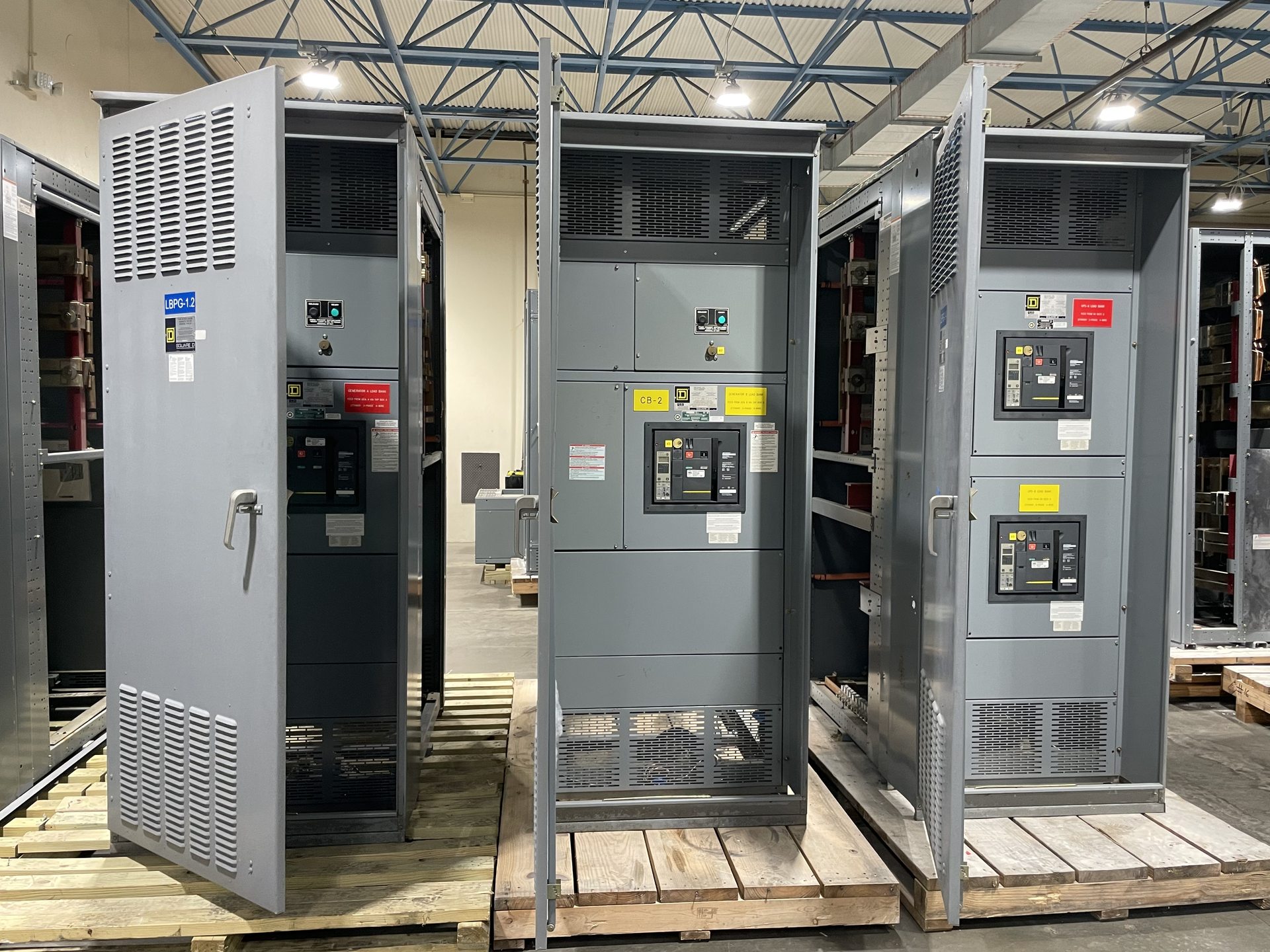
Start with the MCC’s configuration
If you are responsible for surplus or decommissioned equipment in Indiana, describe whether the 480-volt motor control center is being offered as complete sections, as loose buckets, or as a combination. That distinction helps a buyer understand what is included. A lineup may include its structure and multiple installed units, while loose buckets are individual components whose quantity and identification matter. Do not assume that a partial lineup has the same scope or value as a complete one.
Clarify what remains with the equipment, based on records or information already available: for example, whether sections are together or separated, whether buckets are included, and whether documentation accompanies the MCC. If the equipment is still installed or operating, you may inquire using information you already have. Do not open, operate, or approach it to gather details.
Share nameplate details only when safely available
A clear exterior nameplate photo or a transcription of safely accessible markings can help identify the equipment. Useful information may include the manufacturer, catalog or type designation, rated voltage, current ratings, and other printed identifiers. Share only what is available without entering an unsafe area or approaching energized equipment; inaccessible details are not a reason to inspect or handle the MCC.
Keep a rating separate from a statement about present conditions. A nameplate marked 480 volts identifies a rated value; it does not by itself verify the voltage currently present at the equipment. If a detail is uncertain, say so rather than presenting an assumption as verified. Never touch energized equipment.
Explain whether the offer concerns sections or buckets
When describing complete sections, state how many sections are included if that information is known, and whether they are part of one lineup or separate groups. For loose buckets, give the known quantity and any visible identifying information. If quantities or configuration are unclear, describe the uncertainty plainly. A buyer can evaluate the available information without expecting you to open compartments, remove units, or test components.
Condition descriptions should likewise distinguish observation from history. You can report a known service history, a recorded reason for removal, or visible exterior damage already documented. Do not infer internal condition from appearance, and do not test the equipment to establish a condition report. Testing is not required to make an inquiry.
Provide context that helps evaluate the equipment
Along with the configuration and markings, useful information may include the facility location in Indiana, ownership or authorization to sell, available equipment lists, photographs already on hand, and known condition. A buyer may need to understand whether the MCC is surplus, used, or decommissioned and whether related sections or buckets are part of the same offering. Share what you can access safely; not every inquiry will have every detail.
If the MCC remains in a facility, say that clearly rather than implying it has already been removed. The business buys equipment; it does not sell MCCs. It considers equipment across voltage classes, including equipment from closed data centers and power plants, but consideration does not guarantee a purchase or an offer.
Understand handling responsibility before a purchase
For equipment that is purchased, the buyer handles disconnects and the physical handling arrangements, including crane, rigging, loading, freight, and hauling. Freight is covered for purchased equipment. The seller does not perform or arrange these operations, and should not attempt to move, lift, disconnect, load, ship, or haul the MCC. Sellers also must never enter unsafe areas or approach energized equipment.
These arrangements apply to purchased equipment, not to an assumed sale. A cash offer is not guaranteed, and the available information may affect whether a purchase is considered. Do not treat an initial discussion as confirmation that the equipment has been accepted or that a particular amount or timeline is assured.
Make the inquiry useful without taking on extra work
Gather existing records, exterior photos that are already safely accessible, and a straightforward description of complete sections versus loose buckets. Include the known location and identify any gaps or uncertainties. You do not need to test the MCC or obtain details that are inaccessible. For purchased equipment, payment is made upfront; an inquiry does not guarantee that a purchase will be agreed.
A careful description lets an authorized Indiana seller discuss surplus or used 480-volt MCCs without operating or inspecting equipment. Keep facts, estimates, and unknowns distinct; let the buyer assess the information and, if a purchase proceeds, handle the specified disconnect and logistics responsibilities.