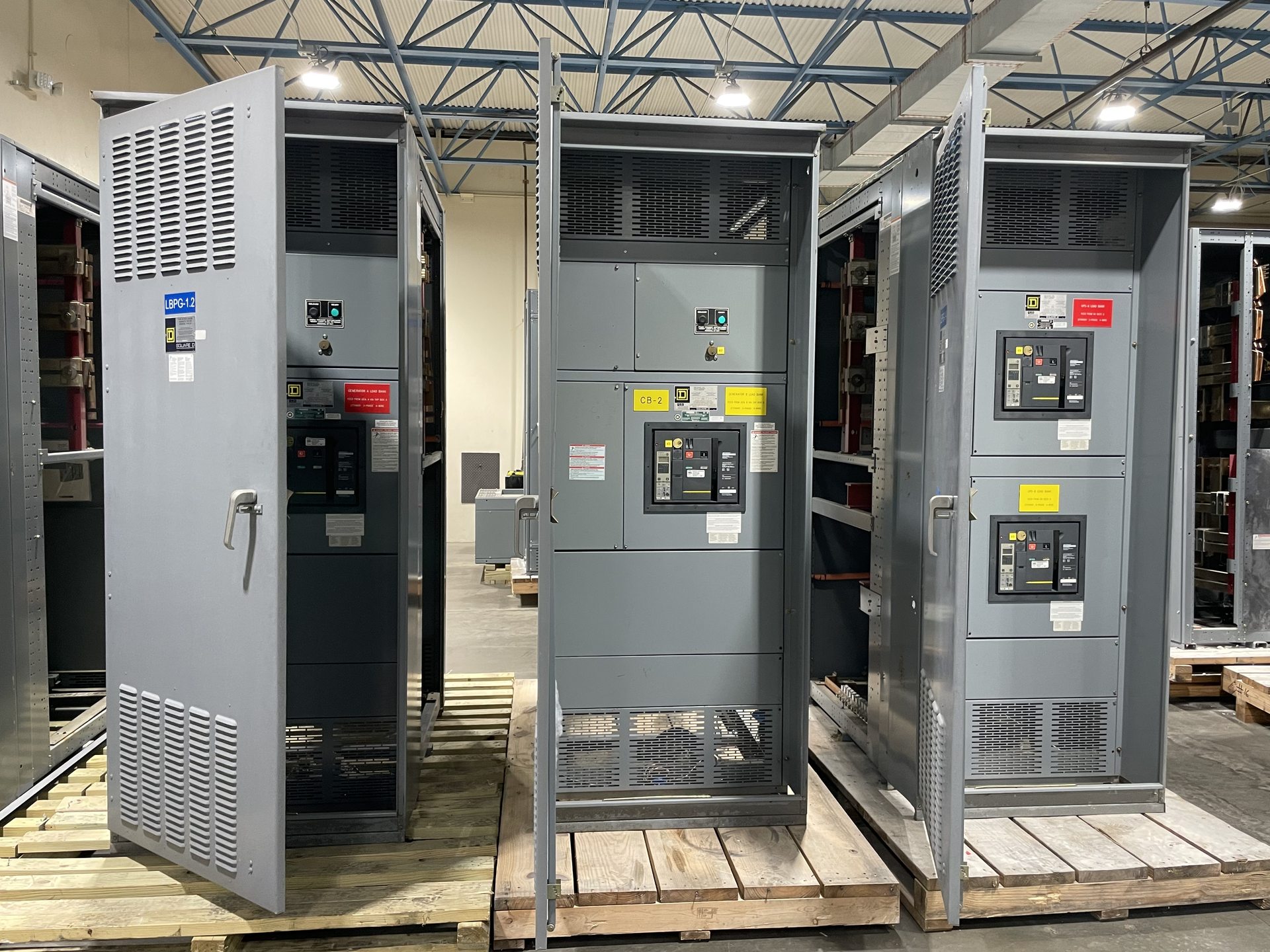
Describe the breaker cell as part of its equipment
A breaker cell or compartment may be offered together with switchgear, a lineup section, or other surplus electrical equipment. For an Indiana facility owner or authorized seller, the first useful step is to describe what is actually available: a standalone cell, one or more sections, or a larger lineup that includes the compartment. These distinctions help a buyer assess the equipment as a group rather than assume that a cell is complete or suitable on its own.
Share information already available, such as the equipment location, ownership, known condition, and any existing equipment lists or photographs. If safely accessible from the exterior, a nameplate photo or its recorded details may help identify the assembly. Do not enter an unsafe area or approach energized equipment to collect information. If the equipment remains installed or operating, you may still inquire using details you already have.
Make included breakers and accessories explicit
Clarify whether the proposed sale includes breakers, shutters, doors, control components, spare parts, or other items that are present with the cell. If a breaker is separate, identify it as separate rather than implying it is included. If you are uncertain whether a breaker belongs with a particular compartment, say so. A clear inventory of what is included and what is excluded is more useful than an unverified compatibility claim.
Breakers are not interchangeable merely because they appear similar or share a broad voltage description. Fit and suitability can depend on the specific switchgear design, ratings, configuration, and other equipment details. A breaker’s label and the cell’s identification may help with assessment, but an uncertain match should remain uncertain until verified. Do not represent a breaker as compatible based only on appearance or an assumption about the lineup.
Use labels carefully when describing ratings
Names, catalog information, and nameplate details can help distinguish a cell from a complete switchgear section. Share the wording as it appears in records or on safely accessible exterior labels, including any known manufacturer, type, or rating information. If details are missing, unreadable, or unavailable without approaching equipment, say that instead of trying to fill the gaps.
A listed voltage rating describes equipment capability; it does not establish the voltage currently present at the equipment. Keep those statements separate. For example, report a rating only when it is documented, and describe operating status only if that information is already known. The buyer considers equipment across all voltage classes, so an unfamiliar or higher-voltage rating is not by itself a reason to rule out an inquiry.
Explain condition without testing the equipment
Useful condition notes can include whether a cell is described in existing records as complete, surplus, decommissioned, or part of a larger closed facility, along with any known missing components or visible exterior damage. Distinguish what someone has verified from what is reported or unknown. You do not need to test equipment to ask whether it may be of interest, and testing is not required for the buyer to consider it.
Never touch energized equipment. Sellers must not open or operate equipment, approach energized equipment, enter unsafe areas, or try to make equipment safe for an inquiry. Do not remove covers or obtain details from inaccessible labels. If information cannot be gathered safely from what is already available, simply note that it is unavailable.
Set expectations for review and payment
The company buys surplus, used, and decommissioned switchgear and related equipment; it does not sell breaker cells to the person making an inquiry. It may consider cells offered with switchgear, switchboards, motor-control centers, panelboards, busway, transfer switches, breakers, or other equipment. Sharing a concise description of the group and its included items can help the buyer decide what further information, if any, is useful.
An inquiry may lead to a cash offer, but an offer or purchase is not guaranteed. If equipment is purchased, payment is made upfront. The seller is not required to test the equipment, and there is no guaranteed price or minimum value. The buyer considers equipment from closed data centers and power plants as well as other sources, and evaluates available information rather than treating every cell as equivalent.
Clarify handling responsibilities before a purchase
For equipment the buyer purchases, the buyer handles disconnects and the crane, rigging, loading, freight, and hauling. Freight is covered for purchased equipment. The seller does not perform or arrange those operations. These responsibilities are worth confirming during discussions so that the proposed scope is clear; sellers should not move, disconnect, lift, load, ship, or haul equipment in preparation for an inquiry.
When describing a potential sale, provide the location and the scope of the equipment using information you can access safely. Include whether the breaker cell is offered with related sections and whether breakers are included, separate, or of uncertain compatibility. That gives the buyer a practical basis to review the opportunity without requiring unsafe access, testing, or assumptions about what the equipment can do.