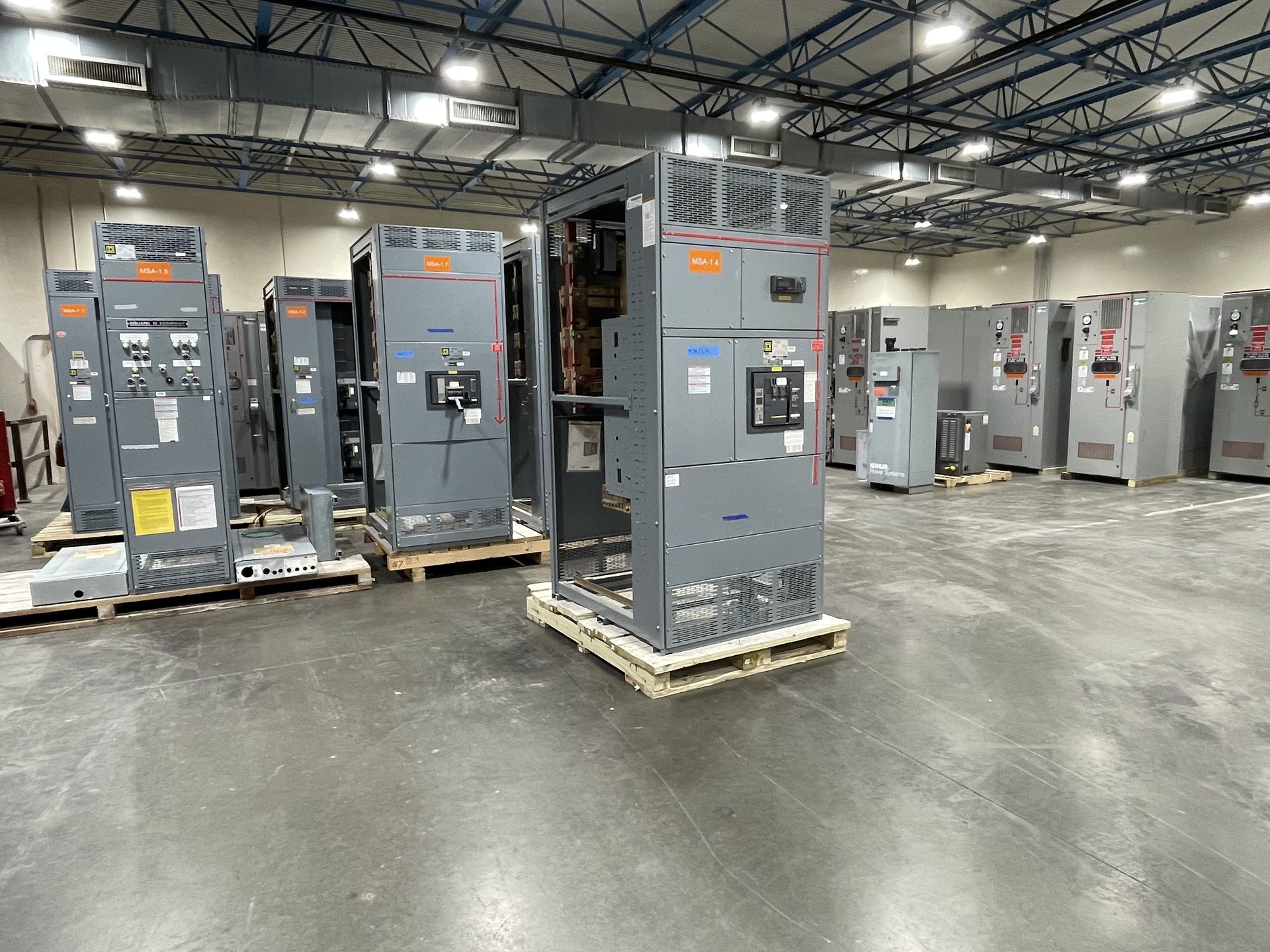
Count the Switchboard Sections as They Exist
When describing surplus switchboard sections, start with the total number of sections associated with the lineup and then identify how many you are offering. Those numbers may differ: an owner might be retaining part of a lineup, or only certain sections may be available. State the distinction plainly rather than presenting the offered subset as the entire assembly. If the count is uncertain, say so and share the best information already available, such as an existing equipment list or records from the facility.
Use “switchboard” for equipment identified as a switchboard, and do not substitute “switchgear” as a general label. The terms describe different equipment categories, and the name on existing records or equipment identification can help clarify what is being discussed. If documentation uses conflicting terms, note that discrepancy instead of deciding the classification from appearance alone. Clear naming helps an authorized buyer assess the inquiry without assuming that every section or lineup is interchangeable.
Describe the Offered Subset and Its Relationship to the Lineup
For a partial offering, explain which sections are included using identifiers that are already available, such as section numbers, lineup labels, or names in a facility inventory. Mention whether records indicate that the offered sections belong to one lineup or come from separate lineups. If that relationship is not known, leave it uncertain rather than implying that the sections form a complete, matching assembly. This context matters when evaluating a group of sections separately from a complete lineup.
Also distinguish between equipment being considered for sale and equipment that is simply present at the site. The business buys surplus, used, and decommissioned switchboards; an inquiry does not commit the owner to offer every section. Sections may be discussed even if they remain installed or operating, using information already available. Never touch energized equipment. Sellers must not open, operate, or approach energized equipment, or enter an unsafe area to obtain details.
Share Available Identification and Ratings Carefully
Useful information may include safely accessible exterior nameplate details, existing photographs, an equipment list, the location, ownership, and known condition. Share what is available without treating every item as a prerequisite. If a plate cannot be safely viewed or a record is missing, say that the information is unavailable. Do not enter a restricted or unsafe area, open a cabinet, or operate equipment to fill in a gap.
Keep a stated rating distinct from live operating voltage. A nameplate rating describes equipment characteristics; it does not establish the voltage present at a particular moment. Report a rating as transcribed from existing information, and identify live voltage as unknown unless it is verified in records available to you. The buyer considers all voltage classes, but that does not make an unverified value a confirmed fact or determine whether a purchase will be made.
Identify Documentation Without Overstating What It Proves
Say what documentation is available and what it covers. For example, an existing lineup schedule might identify section designations, while an equipment list might give a count or recorded rating. If photographs show exterior labels, describe them as photographs rather than as a complete technical record. Note when documents appear incomplete, refer to a larger lineup, or do not clearly match the sections being offered. This lets the buyer compare the offered subset with the information provided while preserving uncertainty.
Testing is not required for an inquiry or for the buyer to consider equipment. Do not test, energize, or operate sections to create information for a potential sale. Known condition can be described in ordinary terms based on information already available, with unknowns identified as unknown. Avoid presenting an assumption about completeness, condition, or compatibility as a verified inspection finding.
Explain Site Context and Handling Responsibilities
Include the Indiana location and any relevant access or space constraints that are already known, without entering an unsafe area to check them. For equipment still installed or operating, say that plainly; it does not prevent an initial discussion based on available information. The seller should not disconnect, move, lift, rig, load, ship, or haul the sections, or arrange those operations. For equipment purchased, the buyer handles disconnects, crane and rigging, loading, freight, and hauling, and covers freight.
Those responsibilities apply to equipment the buyer purchases, not to every inquiry or a guaranteed transaction. The owner should not assume that a section will be removed or that a particular handling plan is settled before purchase terms are established. Sharing known site context helps the buyer evaluate the proposed group without asking the seller to perform work or make equipment safe.
Request an Evaluation Without Assuming a Sale
An authorized seller can present the section count, the number offered, available identifiers, documentation, location, ownership, and known condition in a concise inquiry. A cash offer may be made after review, but neither an offer nor a purchase is guaranteed. For purchased equipment, payment is upfront, and the seller is not required to test the sections. Keep the distinction between facts, records, and uncertainty clear so the buyer can assess the specific switchboard sections being offered rather than an assumed complete lineup.